 Hotels
  Apartments
  Residences
  Villas
  Farmhouse
  Bed&Breakfast
  Camping sites
  Agencies
  Campo nell'Elba
  Rio
Rio  Capoliveri
  Marciana
  Portoferraio
  Porto Azzurro
  Marciana Marina
  Island of Elba
 History of hermitage
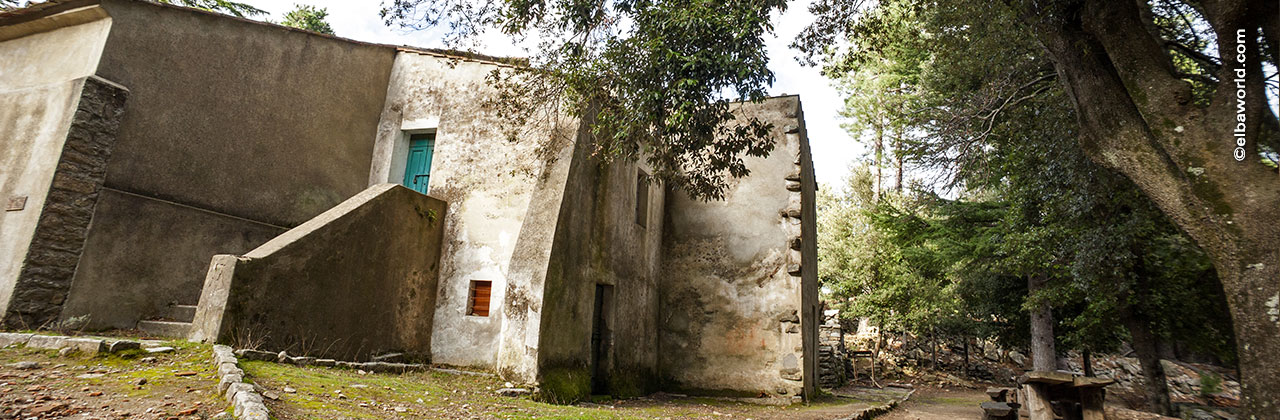
Even if there aren’t rejecting proof, the popular tradiction says that the building of the Hermitage of San Cerbone was made after the death of the saint in 575, in that places where he lived, when he escare from the longobardic raids. This monument is the most ancient of the isle.
In 1421 was founded the monastery consacreted it. The building was strongly wanted by San Bernardino Albizzeschi from Siena, when he was voted as general commissionar of the observants of Umbria and Tuscana. Thanks to the approval of the royal prince of Piombino, Jacopo II, the father of Tommaso from Florence, that was inaugurated the holy place.
That time Marciana and Poggio were two different district and the building of San Cerbone marked the border line. In fact the holy building was built by Jacopo II to satisfy both the populations. The entrance of the hermitage and half nave were under the control of the district of Marciana and the choir and the monastery were under the control of the ex district of Poggio.
The life in monastery lasted no longer and the monchs leaved soon San Cerbone, because of the harshness and the difficulty to reach it. The provincial vicar refused to visit it for these reasons. After the dereliction, the situation of the structure became catastrophic, as the report of Antonio Ferri, general governor of Piombino, in 1736 declared. The roof was precarious and was quite to fall down and insiede the hermitage lived two monchs, that live still now in charity.
The hermitage was adepte by monchs wearing a black monch habit with the holy cross of San Cerbone, that was sewed on the breast. They lived there curating the fields around the churchs and received alms by the believers and tithes on the fishery of the fishers of Marciana.
In 1815, after the nomination of Napoleone at the Isle Elba, the isle joined the grand duchy von Tuscania. The new gouvernment abolished the fishery tithes and let the hermitage without incomes. The chaplain tried to reintroduce the tithe and asked to the gran duchy to carry the legacy. He didn’t succeed in his enterprice but the bishop showed an interest for that holy building, that was consacrated to the protector of the diocese, deciding to adopt some measures to save the holy building.
The Nineteenth century was the century of the downfall of the holy building, because of the few attentions of episcopal curia. Since its foundation, the bishops had decided to have the absolute tutelage, going to the detrimento of the principality of Piombino, that had some rights about it.
In 1868 were applied the roman questions, that took off the goods of the hermitage and and gave them to the Kingdom of Italy, and all the no-holy objects were auctioned, undressing the building and privatizing the residential part of the building and the surrounding fields.
The situation of deterioration lasted for more then a century and its recovery happened in 1979, wanted by the danish noble Viggo Dimitri de Wichfeld, curated by Paolo Ferruzzi and realised by Franco Segnini. The restoration of the current hermitage finished in 1993, when was hung at the outer side of the holy building a commemorative plaque.

San Cerbone
Life of San Cerbone and his hermit life in the valley of the mountain Capanne next to Poggio.




Elbaworld suggests

What to visit
Discover places and attractions nearby.
Recommended excursions
Discover incredibly beautiful excursions on Elba Island.